Japanese director Nishikawa revisits untold story of orphaned girl after WWII
Japanese director Miwa Nishikawa explores the long shadow of war in "Children Untold," centering on an orphaned girl and a woman grappling with the loss of who they once were in postwar Japan.
Reuters / Atsuko Kitayama
15 September 2026 at 16:13:31
Carlos Osario / Reuters
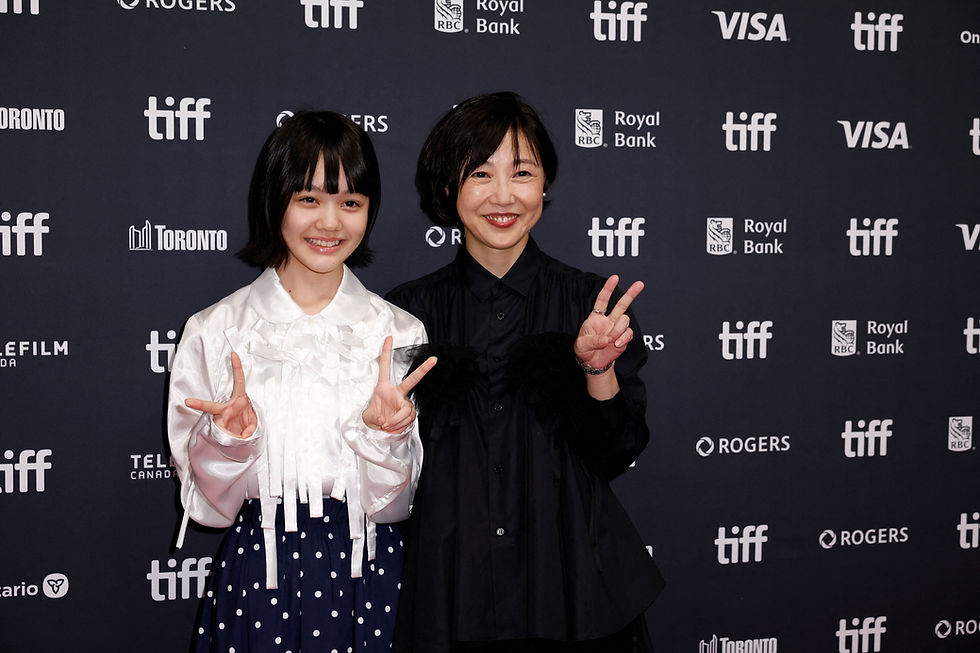
Ami Koyae and Miwa Nishikawa pose during a photocall for "Children Untold" at the Toronto International Film Festival (TIFF) in Toronto, Ontario, Canada, September 10, 2026.
Japanese director Miwa Nishikawa explores the long shadow of war in "Children Untold," centering on an orphaned girl and a woman grappling with the loss of who they once were in postwar Japan.
The film premiered at the Toronto International Film Festival last week, becoming the first Japanese title to open the festival's competitive Platform section.
Set in the aftermath of World War Two, when an estimated 120,000 children were left orphaned, "Children Untold" follows Kotoko, a 12-year-old girl who loses her family and disguises herself as a boy to survive on Tokyo's streets. Meanwhile, her former schoolteacher, struggling to survive herself and forced into prostitution for occupying troops, sets out to find Kotoko.
Though the term "war orphan" often evokes the image of a boy, Nishikawa wanted to focus on girls whose stories have largely gone untold. "There must have been just as many girls orphaned by the war,” Nishikawa said in an interview. “I wanted to examine how they survived and how their lives unfolded."
"War does not end when the fighting stops,” she said. “Even after it is over, people continue to fight different battles in their lives. I wanted today's children to understand that."
When she began developing the film in 2020, Nishikawa feared the theme might feel too distant for modern audiences. But wars in Ukraine, Gaza and Iran have made it more relevant than she expected.
"Rather than my film reflecting today's world, the world itself has moved closer to what I portrayed in the film," she said.
Against a backdrop of global conflicts, Nishikawa said there were growing signs that Japan's pacifist principles, upheld for the past 80 years, were beginning to erode.
As a filmmaker from Hiroshima, where the legacy of war feels especially immediate and personal, Nishikawa described depicting war as "heavy." But she stressed the need to revisit Japan's past mistakes, including how people were swayed by propaganda, drawn into war and failed to take responsibility for its consequences.
The next challenge, she said, was engaging people who felt the subject had already been discussed enough.
“A new generation of creators, not only in Japan but around the world, needs to find ways to carry these stories forward," she said.
-Reporting by Atsuko Kitayama in Toronto; Editing by Caroline Stauffer and Nia Williams/Reuters
TOP ENTERTAINMENT STORIES

TWICE’s Nayeon to meet Filipino fans on November 14

LANY cancels 'Soft World' Davao stop due to safety concerns, production issues

Hello Kitty maker Sanrio ends TV Spy Show partnership after China backlash
LATEST NEWS

Philippine gov't strengthens ecosystem protection against El Niño threat

EXPLAINER: How could an oil spill off the UAE coast threaten desalination plants?

UN says world is falling behind on ecosystem restoration goals
Paraluman News Publication, Inc.
desk@myparaluman.ph
Tektite Towers (East), Exchange Road
Ortigas Center. San Antonio 1600
City of Pasig, NCR, Philippines
+63284298877
EXPLORE
Editorial Standards and Code of Ethics
Privacy Policy
User Policy
COMMUNITY
Contributor and Campus Voices Terms
Advertise with Paraluman News
ACCOUNTABILITY & SAFETY
Submit a Claim for Fact-Checking
© 2026 Paraluman News Publication