China's second attempt at completing a reusable rocket test fails
The first stage of China's reusable Long March 12A "was not successfully recovered" during the rocket's inaugural flight on Monday, according to the state-run Xinhua news agency, as Beijing looks to close the gap with U.S. giant SpaceX.
Eduardo Baptista
December 23, 2025
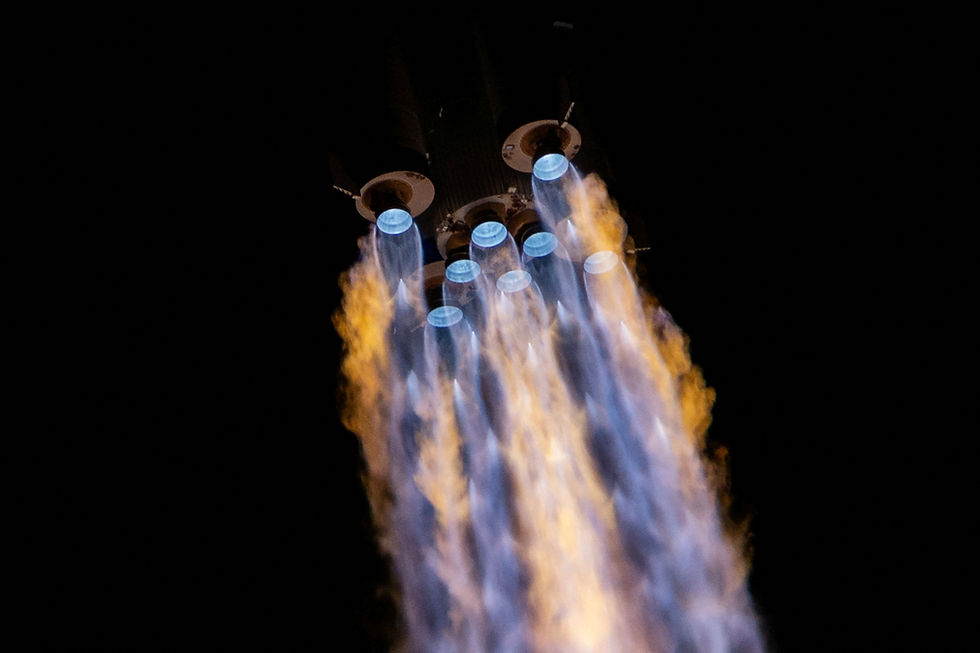
FILE PHOTO: A Long March 2F rocket carrying the Shenzhou-21 spacecraft with astronauts Zhang Hongzhang, Zhang Lu, and Wu Fei blasts off to China's Tiangong space station from the launchpad at the Jiuquan Satellite Launch Center, near Jiuquan, Gansu province, China October 31, 2025. REUTERS/Maxim Shemetov
Maxim Shemetov
BEIJING- The first stage of China's reusable Long March 12A "was not successfully recovered" during the rocket's inaugural flight on Monday, according to the state-run Xinhua news agency, as Beijing looks to close the gap with U.S. giant SpaceX.
The second stage of the rocket did successfully enter its planned orbit, Xinhua reported. The Long March 12A's maiden flight marked China's second attempt at landing and recovering a rocket booster after launch.
China has in recent years launched dozens of rockets that deliver satellites into orbit but has yet to successfully complete a reusable rocket test, which requires the rocket's large lower section, known as the first stage or booster, to be landed and recovered after launch.
With Elon Musk's SpaceX having mastered this capability several years ago, Chinese private and state-owned rocket firms are rushing to test domestically developed reusable rockets.
Reusability is crucial to lowering the costs of rocket launches, which would make it cheaper to send satellites into space. SpaceX's reusable rocket Falcon 9 has allowed its Starlink unit to achieve a near-monopoly on low-Earth orbit (LEO) satellites.
While Chinese firms have sent several hundred LEO satellites into orbit in recent years, Beijing will not be able to catch up to Starlink unless it develops its own version of the Falcon 9.
The race to become SpaceX's primary Chinese challenger intensified earlier this month when private rocket firm Landspace became the first Chinese entity to attempt a full reusable rocket test with the launch of Zhuque-3, though it failed to stick the booster landing.
The developer of the Long March 12A, China Aerospace Science and Technology Corporation, is a state-owned conglomerate with more than 100,000 employees and is the main rocket contractor for the country's space program.
In contrast, Landspace operates as a startup with less than 2,000 staff.
Eduardo Baptista and Ryan Woo/Reuters
LATEST SPORTS NEWS

ASIAN GAMES: Asian Games gold gives Philippines gymnast Yulo redemption
_JPG.jpg)
ASIAN GAMES: Philippines' Yulo adds Asian Games gold to Olympic success

SWIMMING: Japan's Ohashi breaks 200m breaststroke world record for Asian Games gold
LATEST LIFESTYLE NEWS

Gucci breaks with Italian tradition with new 'Made in China' sneakers

More than 1,000 vintage Swatch watches set for auction

Paris exhibition explores Cézanne’s lasting influence on modern art
Paraluman News Publication, Inc.
desk@myparaluman.ph
Tektite Towers (East), Exchange Road
Ortigas Center. San Antonio 1600
City of Pasig, NCR, Philippines
+63284298877
EXPLORE
Editorial Standards and Code of Ethics
Privacy Policy
User Policy
COMMUNITY
Contributor and Campus Voices Terms
Advertise with Paraluman News
ACCOUNTABILITY & SAFETY
Submit a Claim for Fact-Checking
© 2026 Paraluman News Publication